Shopify Payments is a strong default for most merchants. The case for switching kicks in when you cross £500k a month, when over 20% of your volume is international, or when you sell into markets where Stripe's local entity is not the cheapest option.
This piece walks through what Shopify Payments charges in 2026, when a third-party processor beats it on price, and how to run the comparison.
5 Key Facts
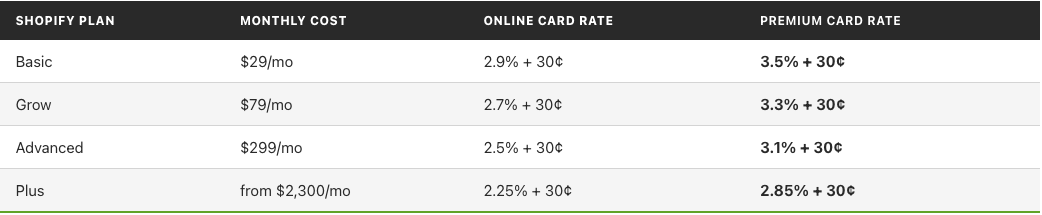
- Shopify Payments charges 2.9% + 30¢ on Basic, 2.7% + 30¢ on Grow, 2.5% + 30¢ on Advanced, and 2.25% + 30¢ on Plus. This is for online card transactions.
- Shopify adds a 2.0% surcharge on every transaction processed by a third-party provider. The surcharge is waived on the Plus plan if Shopify Payments is your sole processor.
- Shopify Payments is built on Stripe's payment rails, but Stripe direct pricing kicks in custom rates earlier than Shopify does.
- Adyen, Checkout.com, and Worldpay offer interchange-plus pricing (typically 1.5% to 1.8% effective for Visa/MC at scale) but require custom contracts and usually a £100k+ monthly volume minimum.
- The break-even for switching off Shopify Payments sits around £500k to £1m of monthly volume for most merchants, depending on plan tier and card mix.
If you sell on Shopify, you have probably looked at Shopify Payments. It is the default option in your admin, it works the moment you turn it on, and the rate looks reasonable. Most merchants stop looking there.
This piece is about that point. When does Shopify Payments go from "good enough" to "expensive"? The answer depends on your monthly volume, your card mix, and how much engineering time you can spend on a swap.
What Shopify Payments actually charges in 2026
Shopify publishes the headline rates per plan. They are different on each tier, and the difference is bigger than most people realise.
Plan-based pricing is one of the things people miss. Basic at $50k/month is 2.9% + 30¢. Advanced is 2.5% + 30¢. That's $200/month or $2,400/year just from upgrading.
Plus merchants get third-party transaction fees waived. The 2% surcharge disappears if you are on Plus and use Shopify Payments as sole processor. This is the most important line in the pricing table.
The 2% third-party surcharge, explained
If you use a processor that is not Shopify Payments, Shopify adds 2.0% to every transaction. A $100 sale routed through Stripe direct on Basic costs 2.9% + 30¢ to Stripe, plus 2.0% to Shopify. Total: 4.9% + 30¢.
Most misunderstood part of Shopify pricing. Merchants hear "use any processor with Shopify" and assume shopping around freely. The 2% surcharge means third-party options must beat Shopify by 2+ points.
Important: The surcharge is waived only on Plus when Shopify Payments is the sole processor. Most merchants under £1m/month are better off staying on Shopify Payments even when alternatives look cheaper on paper.
When the alternative is actually cheaper
The maths flips at certain volumes. Three scenarios where a third-party processor beats Shopify Payments despite the surcharge:
1. You process over £500k a month and want interchange-plus pricing.
Adyen, Checkout.com, and Worldpay offer this at scale. For a UK merchant with mostly domestic Visa/MC, the effective rate lands around 1.5% to 1.8% + a small fixed fee. That is 0.7 to 1.4 percentage points below Shopify's 2.5% Advanced rate. On £500k a month, that is £3,500 to £7,000 in savings, easily enough to absorb the 2% surcharge and come out ahead. The catch: requires a custom contract and £100k+ monthly volume to be approved.
2. You sell heavily into markets where Shopify Payments is not the cheapest option.
A US merchant selling into Latin America pays 2.9% + 30¢ domestic, but international cards add 1% on Shopify. A merchant selling 50% international volume is paying closer to 3.4% on the international half. Adyen's local payment methods in Brazil (Boleto, Pix) and Mexico (Carnet, SPEI) cost 1% to 2.5%, significantly lower than the international card rate on Shopify.
3. You want a different checkout experience.
Subscription merchants paying 2.9% + 30¢ on every recurring charge plus Stripe Billing 0.5% are at 3.4% effective. A subscription-specialised processor or a direct Stripe integration with optimised Billing pricing can land at 2.5% to 2.8% on recurring volume.
What switching actually looks like
If the maths says you should switch, here is what you are signing up for. Four practical steps, in order.
1. Get the rate quotes.
Adyen, Checkout.com, Worldpay, and Stripe direct all offer custom pricing for volume merchants. The quotes take 2 to 4 weeks. You will need to share three to six months of processing statements.
2. Compare on like-for-like.
The headline rate is rarely the rate you pay. You pay interchange plus their markup. Get them to commit to an effective rate for your card mix over a 90-day window. If they will not commit, walk away.
3. Understand the integration cost.
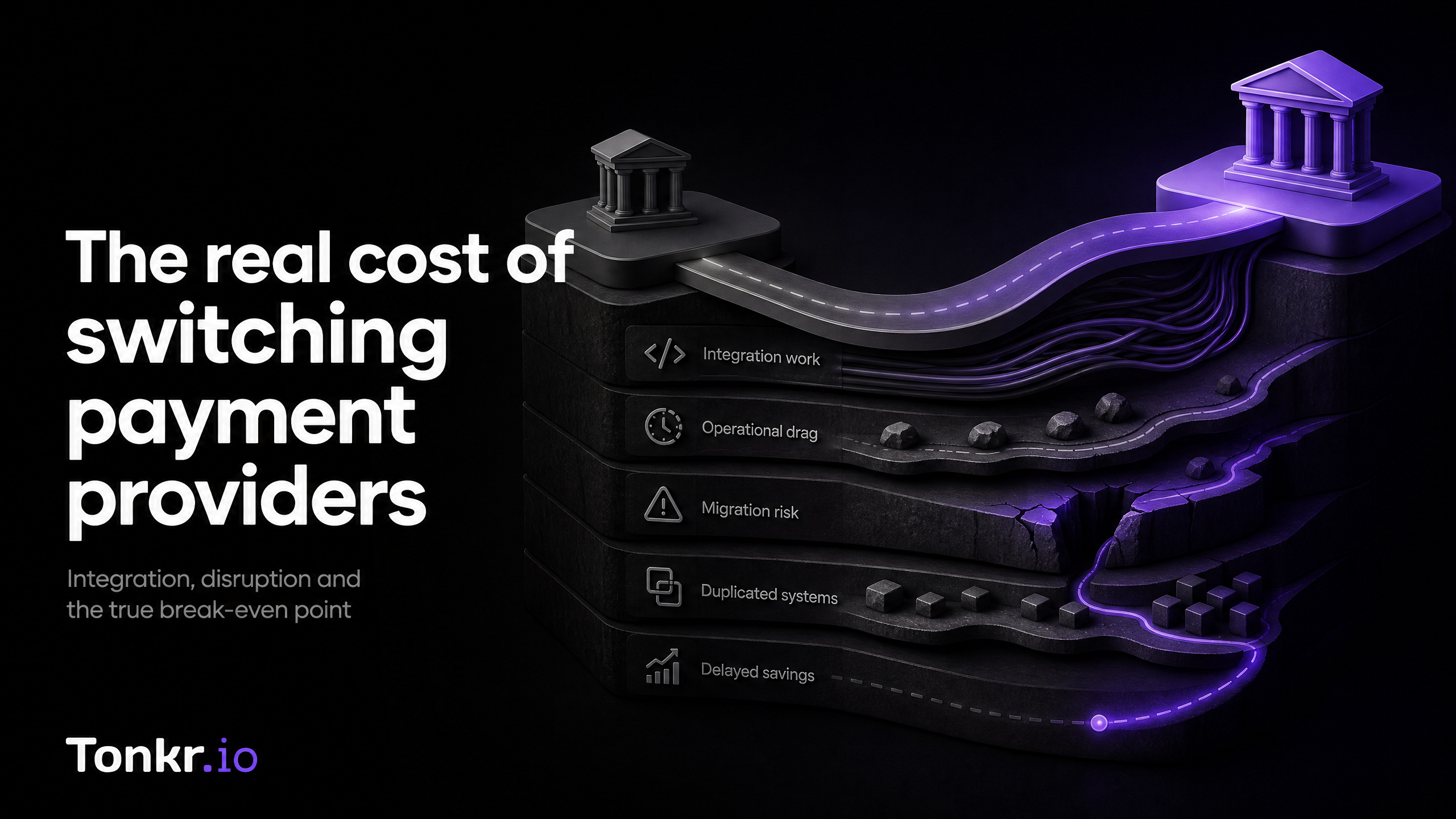
Switching off Shopify Payments means either using Shopify's third-party gateway integration (still subject to the 2% surcharge unless you are on Plus) or building a headless checkout outside Shopify, a six-figure engineering project for most merchants.
4. Account for operational drag.
Two dashboards, two support teams, two fraud tools. Plan for 2 to 6 months of overhead. For most merchants, this costs more than the headline savings for the first year.
The honest version: switching off Shopify Payments pays off at scale, but for most merchants under £500k a month, the savings do not justify the disruption. The break-even depends on your card mix, refund rate, and engineering capacity, not just volume.
The math on your specific situation
Three numbers decide whether switching is worth it:
Monthly volume. Below £500k, the answer is almost always stay on Shopify Payments. The savings do not justify the operational overhead.
International card percentage. Above 20% international volume, Shopify Payments adds +1%. A merchant at £1m/month with 30% international lands at ~2.8% blended. Interchange-plus at 1.7% effective saves ~1.1pp £11k/month.
Your engineering capacity. A merchant with a senior payments engineer can integrate Adyen in 4 to 6 weeks. A merchant without one should plan for 3 to 6 months and budget £50k to £150k for the integration. The savings only make sense if you can absorb this cost.
What the free comparison looks like
This is the bit most merchants do not realise. The comparison is fixed: pull three to six months of statements, identify your effective rate, model interchange-plus pricing.
Tonkr runs this comparison for free. You get a one-page summary showing what you are paying today, what an alternative provider would charge at your volume, and whether the gap justifies switching. The negotiation, if you want us to run it, is on a success basis. We only get paid if we save you money.
If this feels too much, send Tonkr three to six months of statements. Free benchmark, no obligation.
The real question
The real question is not "is Shopify Payments the cheapest option?" It is "is Shopify Payments the cheapest option for our volume, card mix, and engineering capacity today?" Most merchants never revisit it. Annual payments reviews take an afternoon and recover 5 to 30% of processing cost, year after year. Few teams do them.
Tonkr runs them for free as the first step. If you want help after that, we negotiate on your behalf. If you would rather take the findings and run them yourself, that works too. Expect to recover about half of what we would.
Want to see if you are overpaying on Shopify Payments?
Send Tonkr three to six months of statements →
Sources
- Shopify: Basic 2.9%+30¢, Grow 2.7%, Advanced 2.5%, Plus 2.25%, 2% surcharge. shopify.com/pricing (1 Sept 2026).
- Stripe US: 2.9%+30¢, intl +1.5%, FX +1%, dispute $15. stripe.com/pricing (1 Sept 2026).