Losing your payment service provider is always frustrating, but it should not affect your sales or day-to-day operations. The difference between a costly, frantic scramble to keep your checkout online and a seamless transition comes down to how you handle the first 30 to 90 days.
- Global relevance: The advice below applies to businesses in all international markets.
- Sector focus: We look closely at travel, custom retail, pharmaceuticals, subscriptions, and industries with long fulfilment cycles.
- Tailored advice: Because every region has its own rules, we have kept this overview general. You can contact us directly for specific local guidance.
Navigating your notice period
When a provider issues a termination notice—often citing a "portfolio review" or a "commercial decision"—the immediate temptation is to panic and rush into an agreement with the first alternative you find online. This is usually a mistake. Most account closures move slowly, leaving you with a defined window for negotiation and planning. Managing this timeline deliberately protects your card approval rates and gives you the space to secure a reliable replacement without losing revenue.
"Firstly, don't panic, because there is usually a tail-off time. A lead-out time of 30 to 90 days. And I'd say in a small percentage of cases there is a chance to have the decision overturned."— Akil Downes, Tonkr
Choosing the right approach for your situation
Account closures rarely happen for identical reasons, meaning that treating every notice with the same generic response is a significant misstep. These situations generally stem from two completely different corporate scenarios.
1. The policy shift
This happens when a provider decides to stop working with an entire industry, country, or risk tier.
Having your account terminated is usually not individual businesses' faults, as they often fall within a broader category the provider has chosen to stop supporting. For instance, a processor might suddenly pull away from long-lead-time retail, or decide that subscription models with auto-renewing trials carry too much administrative weight.
Fortunately, these macro decisions often leave some room for negotiation. If you are an established business with strong volumes and excellent reviews, your account manager might be willing to present your file to the risk committee and secure an exception. Financial institutions prefer to retain profitable relationships rather than risk contract disputes or lose good clients to direct competitors.
2. The hard stop
This is a much more urgent scenario where a provider has lost their operating licence, faced regulatory action, or identified a critical compliance issue within your account.
In these circumstances, the decision is absolute and non-negotiable. Your transition window is severely compressed, occasionally leaving you with as little as five to ten working days to migrate your systems.
Because an appeal is pointless here, your priority must immediately shift to damage control. You need to launch a temporary processing solution straight away, while sourcing an ideal long-term partner in parallel.
"If it's a hard stop, where there is no flexibility because they have lost their licence or faced sudden intervention, you need to explore your options immediately. But if the decision is based on increasing fraud trends within your sector or general uncertainty in the market, that is where there is room for discussion."
— Akil Downes, Tonkr
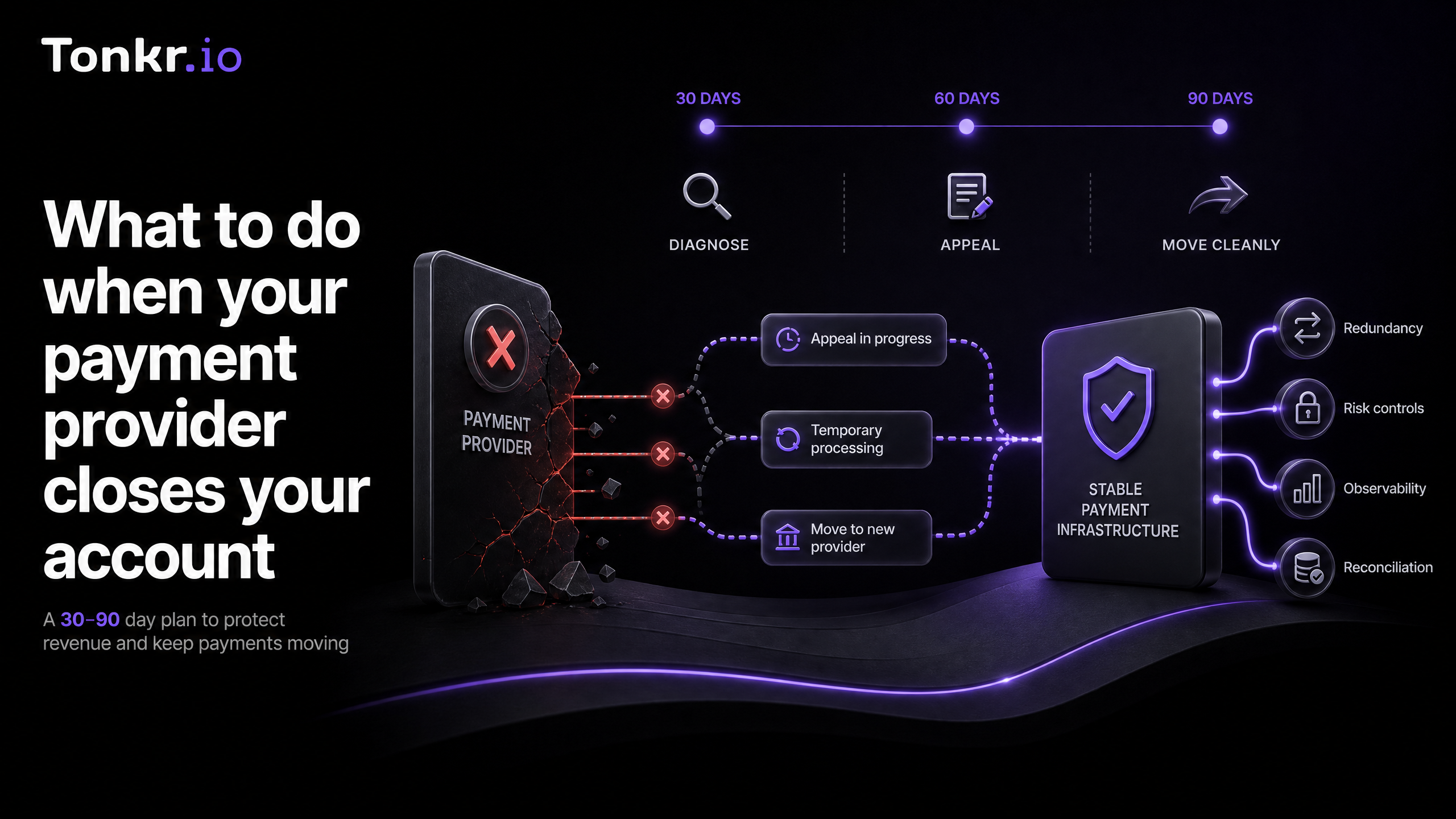
A phased plan for the first 90 days
If you have been granted a standard notice period of one to three months, you can approach the transition methodically across three distinct stages.
Days 1–7: Diagnose and stabilise
Start by asking for explicit, written confirmation of the final termination date alongside the exact reasons for the closure, because uncovering the precise operational concerns gives you a firm basis for negotiation. Concurrently, you should map your entire payment setup to identify exactly which acquirers, alternative payment methods, and software integrations are affected by the notice.
Open a direct line of communication with your account manager immediately, as an internal advocate remains your best route to senior risk decision-makers. Finally, avoid alerting your broader team or your clients prematurely, as doing so creates unnecessary distraction while you are still shaping the strategy.
Days 7–30: Appeal and prepare
To build a formal case for reversal, gather your processing data, client retention history, and positive testimonials to demonstrate stability. If the provider features your business as a success story on their website, use that marketing material as leverage. You can also suggest practical steps to lower their risk exposure, such as adjusting settlement schedules, introducing rolling reserves, or implementing tighter identity verification checks.
While pursuing an appeal, begin parallel discussions with independent payment consultants who understand your sector, as their connections can quickly introduce you to alternative providers who welcome your specific business profile.
Days 30–90: Move cleanly
Selecting a replacement provider under duress frequently results in inflated transaction fees, slower settlement terms, and poor checkout performance, so avoid rushed agreements. Instead, prioritise conversations with providers you have evaluated in the past, as these warm leads can typically complete the onboarding process far quicker than a cold introduction.
Remember that integrating a temporary payment option for a few months while a premier partner completes full underwriting is much more cost-effective than entering a restrictive, long-term contract with an unsuitable vendor. Once live, check your checkout completion rates carefully during the first week, because minor configuration errors during a migration can quietly reduce transaction approval rates by up to fifteen per cent.
"When you are under pressure and act impulsively, you might choose a provider that triples your fees and delays your settlements. That immediately hurts your cash flow, harms the client experience, and stalls your growth."
— Akil Downes, Tonkr
Market sectors facing heightened scrutiny
Risk thresholds evolve continuously, but clear patterns indicate which business models currently face real pressure from financial institutions.
- Travel and leisure: Extended delays between the point of sale and service delivery naturally elevate the risk of chargebacks and refund demands, prompting institutions to tighten criteria or restrict specific subsectors entirely following isolated market events.
- Custom and bespoke retail: Businesses offering custom items with lengthy production schedules encounter similar challenges, as financial partners view extended fulfilment timelines as an inherent delivery hazard.
- Trial-based subscriptions: Short trial periods that transition into premium recurring fees face intense regulatory oversight, and many providers now decline this volume to protect their own institutional reputation.
- Pharmaceuticals and supplements: Complex, shifting regulations combined with high customer dispute rates have led several prominent card processors to reduce their exposure to this sector over the past eighteen months.
- Offshore structures: Financial companies are displaying significantly lower tolerance for businesses registered in low-tax jurisdictions that lack physical operational substance or local staff.
Securing operational resilience
True stability does not mean maintaining a single relationship at all costs, but rather building a robust infrastructure that insulates your company from sudden industry changes, protects your profit margins, and delivers a smooth checkout experience for your clients.
Do you have this problem? Reach out today, we are here to help