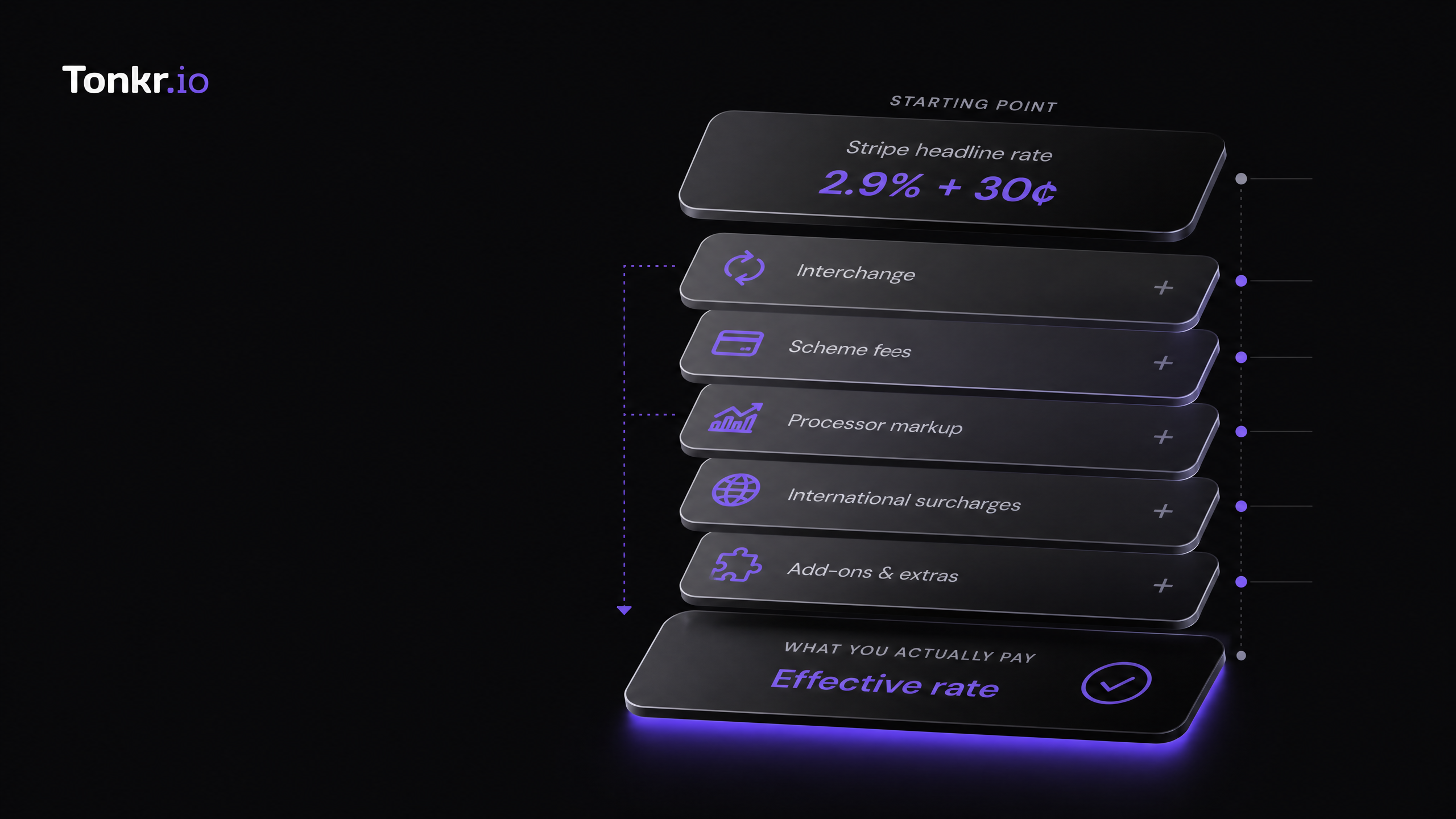
Stripe's headline rate is 2.5% + 20p for UK online card transactions. Most merchants pay more than that once interchange, scheme fees, and add-ons are layered on, and the spread is wider than the marketing rate suggests.
5 Key Facts
- Stripe charges 2.9% + 20p per UK online card transaction.Standard rate, no negotiation required.
- Interchange + scheme + processor fees are typically rebundled into your effective rate. Real costs vary by card mix and country.
- Interchange alone is roughly 0.2% + 1p on a UK consumer debit card.Passed through, marked-up, or bundled depending on the PSP.
- Three pricing models dominate: flat-rate (Stripe), interchange-plus (Adyen, Checkout.com), and tiered (legacy acquirers). They mask different cost levers.
- Most merchants revisit PSP pricing only during a re-platforming event.Quarterly statements should be the trigger.
Stripe charges 2.5% + 20p on domestic card transactions. That is the headline. It is also a small part of what most merchants actually pay once international surcharges, scheme fees, dispute fees, and Stripe add-ons are counted.
Most merchants think they are paying 2.5%. Some are paying 3.5%. The difference is usually hidden in the international card surcharge and the add-on services they subscribed to without realising.
The Headline Rate
Stripe's published pricing for UK merchants is 2.5% + 20p for European cards, with a higher rate for international cards. The 2.5% is competitive for low-volume merchants processing under £500k per month. Above that volume, the picture changes.
The headline is fine. It is the add-ons that push most merchants above 3%.
What the rate actually covers
Every card transaction has three cost layers. Stripe shows you the top one. The other two are passed through with less fanfare.
- Interchange: paid to the cardholder's bank. Roughly 0.2% + 1p on a UK consumer debit card.
- Scheme fees: paid to Visa or Mastercard. Small, but non-zero.
- Processor markup: Stripe's own fee. The 2.5% + 20p.
On a £50 sale from a UK consumer debit card via Stripe Checkout, the breakdown looks like this:
- Interchange: £0.10
- Scheme fees: £0.05
- Stripe markup: £1.30
- Total: £1.45
That is £1.45 to move £50. Most merchants see this and accept it as the cost of taking cards. They are right to accept it. They are wrong if they assume every transaction costs the same.
Where the extra 1% comes from
If your effective rate is 3.5% instead of 2.5%, it is coming from one of these:
International cards
Cards issued outside the UK carry a 1.5-3% surcharge on top of the headline rate. If 20% of your volume is European or international, your effective rate is no longer 2.5%.
AMEX
AMEX rates are higher than Visa or Mastercard. Stripe's AMEX pricing is competitive relative to other PSPs, but it is still higher than the headline.
Currency conversion
If you accept payments in a currency other than your settlement currency, FX fees apply. The 1-2% is built into the published rate but is not visible unless you are looking for it.
Dispute fees
£15 per chargeback, regardless of outcome. If your dispute rate is above 1%, this adds up fast.
Other fees
Stripe Billing (subscriptions) is 0.5% extra on recurring charges. Stripe Tax is 0.5%. Stripe Invoicing is 0.4%. Stripe Terminal is 1.5%. None of these are hidden, but they are not in the headline either.
The headline rate tells you the minimum. Your effective rate tells you what you are actually paying. Pull three months of Stripe statements and divide total fees by total volume to find it.
When Stripe is the right choice
Stripe is competitive when:
- You process under £500k per month
- You want one integration across UK, EU, and US
- You use Stripe Billing, Tax, or other add-ons
- You want simple integration and strong security. If your developers can handle an API integration, they can work with any provider, so a simple, secure setup is the genuine advantage here
- You want transparent pricing without negotiation
When Stripe is not the right choice
Stripe is expensive when:
- You process £500k+ / $500k+ per month (the headline rate becomes the floor, not the ceiling)
- International volume exceeds 20% of your mix
- You pay for add-ons you no longer use or are not benefitting from. Some add-ons have been shown to negatively impact sales: one merchant attributed a sales drop to an AI fraud-screening module
- Your dispute rate exceeds 0.50%. Above this level, Stripe is not actively guiding merchants towards better performance, and past 0.80%, Tier 1 and Tier 2 processors begin declining accounts or imposing conditions: cash or rolling reserves, delayed settlements, or enforced rules such as full 3DS on all transactions with no TRA exemptions
- Competitors are actively approaching you. When providers start courting your business, it is time to consider alternatives
What to do about it
You have three options. Each one works. Most merchants never pick any of them because they assume the headline rate is fixed.
Option 1: Bring in Tonkr. We run the audit, negotiate on your behalf, or run the alternative-provider quote exercise. The process is free so theres nothing to lose. Across 50+ clients in the £250k-£2m/month band, the average saving is 25-30% of total processing costs, mostly through interchange optimisation, removal of unused add-ons, and sometimes a PSP switch. This is the default path for most merchants because the audit costs nothing and removes the work of running the comparison yourself. We see what works because we run this conversation every week.
Option 2: Get quotes from alternative providers. At your volume, Adyen, Checkout.com, Worldpay, and Stripe direct are all willing to quote. Most merchants do not realise how competitive the interchange-plus market becomes once you cross £500k/month. Bringing a credible competing quote to Stripe usually doubles what they will offer on their own. We have seen merchants move off Stripe entirely for a 0.7 to 1.5 percentage point improvement, or use the quote to push Stripe to match. This is a viable DIY path if you have time and a payments engineer.
Option 3: Negotiate directly with Stripe. Stripe will negotiate above certain volume thresholds, but only if you ask. They will not offer. The success rate depends heavily on knowing which questions to ask, which add-ons to challenge, and how to frame the conversation against competitors you have quoted. Rough benchmarks from what we see:
- £500k-£1m/month: 10-15% reduction achievable
- £1m-£3m/month: 15-25% reduction achievable
- £3m+/month: 20-35% reduction achievable
This is the most work and the lowest recovery. Expect to recover about half of what Tonkr would, because the negotiation is where the contacts and the framing matter.
The real question
The real question is not "is Stripe cheap?" It is "is Stripe cheap for the volume and mix you process today?" Most merchants never revisit the question. The PSP industry depends on that. Annual price reviews take an afternoon and recover 15-25% of processing cost, year after year. Few teams do them.
Want to see if you are overpaying on Stripe? Send Tonkr three months of statements and a list of which add-ons you actively use. We will benchmark against current market rates for free.
The numbers
2.5%: Stripe's UK headline rate3.5%: Effective rate most merchants pay15-25%: Negotiation savings above £1m/month