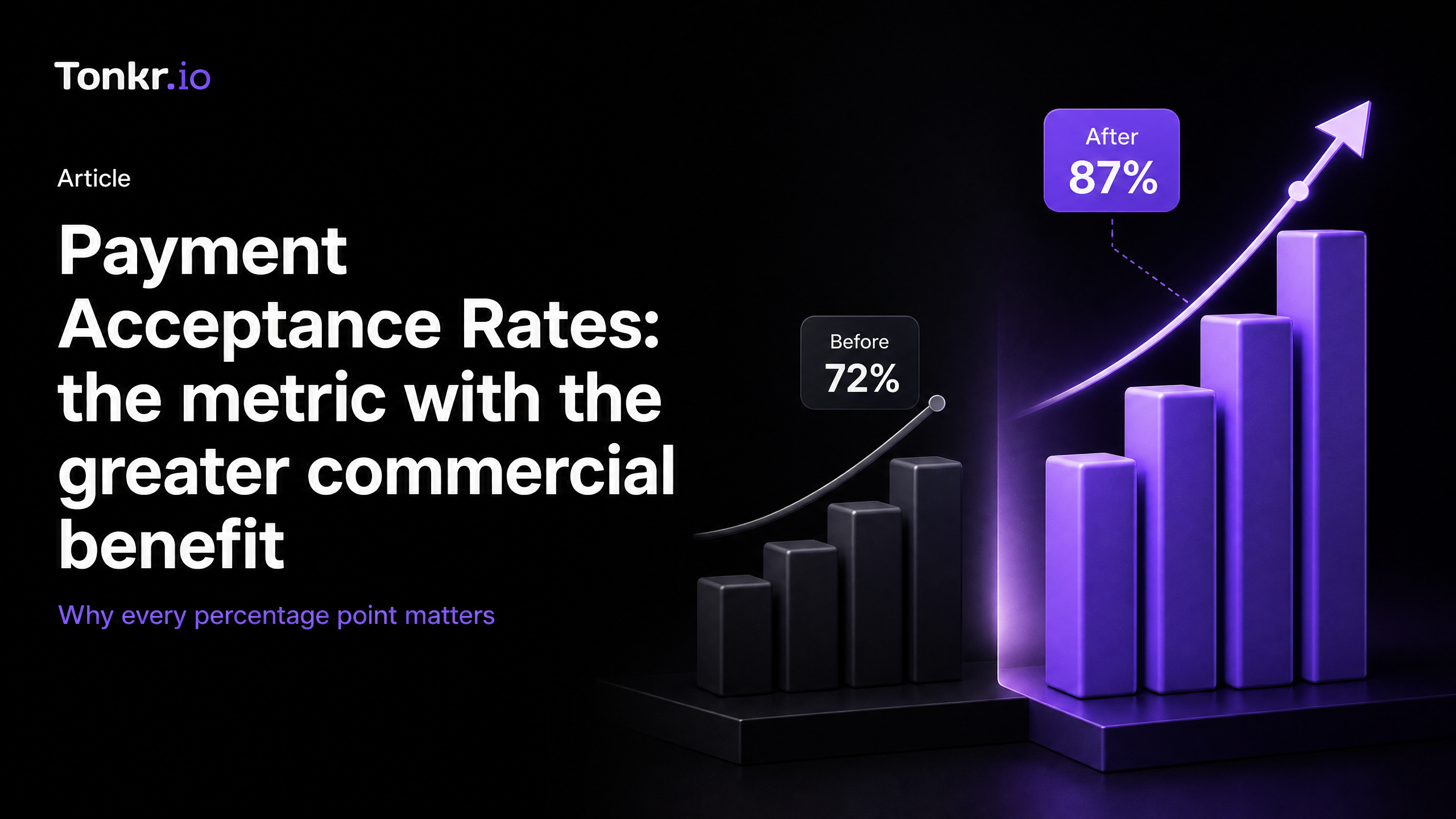
Acceptance rate, the percentage of valid transactions that succeed, moves more revenue than fee optimisation for most merchants above £10M turnover.
5 Key Facts
Excellent Acceptance Rates sit at 90 to 95% of valid transactions completing.A 3% acceptance uplift on £200m turnover is roughly £6m in found annual revenue.Acceptance Rates vary by 7 to 12% across providers on low-risk retail.Issuer risk tolerance, customer risk profiles, and shared fraud data drive most declines.Fee optimisation saves basis points; higher Acceptance Rates recover whole transactions.
Ask a merchant what they pay in processing fees and they can answer within seconds. Ask them what their Acceptance Rate is and most cannot. That difference matters, because merchants and payments providers alike tend to overfocus on small, incremental fee reductions when there are often far greater financial benefits in turning declined transactions into approved ones.
What Acceptance Rates actually measure
An Acceptance Rate (Approval Rate) is the share of legitimate, fundable transactions that complete successfully. It excludes customer mistakes like mistyped card details and genuine fraud attempts. What remains is the population of good customers whose payment failed for reasons the merchant or its providers control.

Why Acceptance Rates vary by 7–12% across providers
For low-risk retail, traditional acquirers such as Worldpay and Barclaycard often outperform newer entrants on raw approval rates. The difference is not marketing; it is infrastructure and issuer relationships.
Issuer risk tolerance. Banks apply tighter risk rules to new merchants and high-risk verticals such as gambling and forex. Newer providers without established issuing bank relationships normally experience more declines.
Customer risk profiles. Issuers score the customer as well as the merchant. Returning customers with clean history get approved more often than first-time buyers at borderline-risk sites.
Shared fraud data. Providers contribute to centralised repositories of risky cards and individuals. Merchants on providers with better data feeds inherit fewer false declines.
Acquirer and processor risk profile. Established processors carrying a poor track record, whether through high fraud levels, customer complaints, or a portfolio skewed towards high-risk clients, experience lower Acceptance Rates because issuing banks treat their traffic with wariness. Well-established providers with clean portfolios, and sometimes even newer competitors, clear that bar more easily.
The larger financial benefit
Fee negotiation is a basis-points game. A 0.3% fee reduction on £200m turnover saves £600k a year, which is worth saving. Whereas a 3% acceptance rate improvement on the same turnover recovers roughly £6m in revenue that was already earned but never captured.
Compare like with like: before switching providers on price alone, benchmark Approval Rates alongside fees. A provider that is 0.2% cheaper but 5 points worse on approvals is dramatically more expensive
What to do about it
Pull 90 days of transactions and compute your Acceptance Rate: successful payments divided by valid attempts. Split it by card type, geography, and daypart. If you land below 90%, there are significant financial benefits available in retry logic, routing rules, and provider choice.
Tonkr benchmarks Acceptance Rates as part of the free audit. Three months of statements, one page: what you are accepting today, what providers in your category achieve, and where the gap is. If we find a greater commercial benefit, we tell you how to capture it. The negotiation, if you want it, is on a success basis.
Related reading
- Acceptance Rate calculation models (Adyen | Checkout)
- Simple: Use of this method is not advisedSuccessful transactions / Attempted transactions
- Standard:Successful transactions / Attempted transactionsExclude Hard Declines
- Advanced:Successful transactions / Attempted transactionsExclude Hard DeclinesExclude attempted transactions where the final attempt was successful e.g. three attempts where the third was successful
Do you know your acceptance rate?
Send Tonkr three months of statements →
Free audit. No obligation.